Is Basement Waterproofing Worth It?
Basement waterproofing is worth it when a basement has recurring water intrusion, persistent moisture, drainage problems, or a foundation-related risk. Not every basement needs it — here’s how to tell the difference.
Signs Your Basement May Need Waterproofing
Any one of these, observed more than once, points to a water source worth inspecting.
Recurring Leaks
Water enters after rain or snowmelt, again and again.
Damp Walls
Foundation walls stay moist without visible standing water.
Standing Water
Water pools on the floor after storms or heavy snowmelt.
Efflorescence
White mineral deposits form as water evaporates through the wall.
Musty Odors
A persistent smell signals microbial growth from trapped moisture.
Water Stains
Discoloration on walls or floors marks past water contact.
Mold or Mildew
Visible growth develops on damp drywall, wood, or masonry.
Recurring Moisture
Dampness returns shortly after the area is dried.
Weather-Linked Intrusion
Water shows up consistently within hours of rainfall.
When Waterproofing Is — and Isn’t — Actually Worth It
Waterproofing is justified by evidence of water, not by a sales pitch alone.
It’s worth it when…
Recurring leaks, standing water, damp walls, water stains, efflorescence, musty odors, foundation cracks, cove-joint leakage, or hydrostatic pressure are present.
You’re planning to finish the basement, or store valuable belongings there.
It may not be necessary when…
The basement has stayed dry across multiple seasons, including after heavy rainfall, with no history of moisture or intrusion.
An inspection — not a sales estimate alone — confirms whether real moisture exists before a system is recommended.
What Causes Basement Water Problems?
Groundwater pressure, poor surface drainage, and foundation defects let water reach interior spaces.
Hydrostatic Pressure
Saturated soil pushes continuously against foundation walls and floors. Water moves through any crack, joint, or porous surface it can reach.
Poor Grading, Gutters & Downspouts
Negative grading and downspouts that discharge too close to the house send surface water straight at the foundation.
Foundation Cracks & Cove Joints
Shrinkage cracks, water-entry cracks, and the wall-floor cove joint each behave differently. The entry point decides the repair.
What Happens If You Don’t Waterproof a Wet Basement?
A wet basement, left alone, tends to recur with every rain event rather than resolve on its own.
Moisture, Mold & Musty Odors
Persistent moisture creates the conditions mold needs: water, an organic surface, and time.
Damage to Flooring & Belongings
Carpet, drywall, framing, and stored items absorb water and can warp, stain, or deteriorate.
Foundation-Related Risk
Ordinary seepage differs from structural movement. Bowing or stair-step cracking calls for an engineer, not just waterproofing.
Benefits of Basement Waterproofing
7 measurable outcomes when the water source is correctly addressed.
Controls Water Intrusion
Manages water at its source instead of letting it recur every season.
Protects the Foundation
Reduces the foundation’s exposure to recurring water and moisture.
Reduces Persistent Moisture
Lowers the humidity that feeds mold, mildew, and musty odors.
Protects Belongings
Keeps stored items, flooring, and finishes out of standing water.
Improves Usability
Turns a damp, unused basement into functional square footage.
Supports Future Finishing
Gives drywall, flooring, and insulation a dry surface to be installed over.
Improves Buyer Confidence
A documented, warrantied system reduces objections during a home sale.
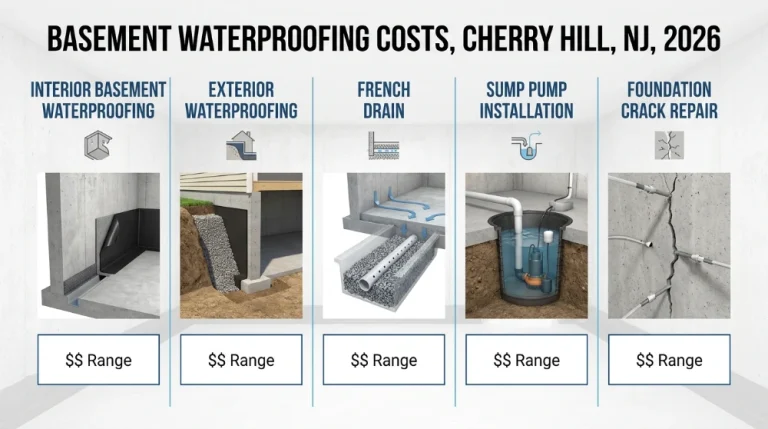
What Basement Waterproofing Actually Costs
A minor crack repair and a full exterior excavation address different problems — and cost very differently.
Typical Ranges
10 Factors That Move the Price
- Basement size and total wall perimeter
- Severity and source of the water problem
- Interior versus exterior method
- Excavation requirements
- Drainage complexity and discharge routing
- Sump pump and backup system needs
- Foundation condition and crack repair scope
- Site accessibility
- Material selection and grade
- Local labor rates
Is It Worth the Cost?
It’s worth the cost when the upfront investment is lower than the ongoing cost of repeated water damage — repairs, damaged belongings, mold remediation, and foundation-related repairs.
Mold remediation alone commonly runs $1,500–$3,000+ for a contained area. Waterproofing doesn’t guarantee a fixed return; the comparison depends on the severity of the problem.
Does It Increase Home Value?
It does not guarantee a specific increase in home value, though it can improve buyer confidence and basement marketability during a sale.
A documented system with a transferable warranty reduces buyer objections at inspection — that’s the real lever, not a fixed resale bump.
How Long Does Basement Waterproofing Last?
“Waterproofing lifespan” isn’t one number — each component ages differently.
| Component | Typical Lifespan | Notes |
|---|---|---|
| Exterior membrane systems | 10–20+ yrs | Select membranes are rated 20–30 years |
| Interior drainage systems | 20–30 yrs | Often lasts the life of the structure |
| Sump pumps | 7–10 yrs | Mechanical wear limits pump life |
| Battery backup systems | 3–5 yrs | Battery replacement drives this interval |
| Sealants & crack injections | 5–15 yrs | Varies with product and wall movement |
What Are the Downsides of Basement Waterproofing?
11 real downsides, weighed against a documented water problem.
- Upfront cost
- Construction disruption
- Excavation
- Landscaping damage
- Interior disruption
- Ongoing maintenance
- Sump-pump dependence
- Power-outage vulnerability
- Warranty limitations
- Poor installation risk
- Unnecessary work
Construction & Landscaping Disruption
Interior work: floor removal, noise, dust, 1–3 days. Exterior work: excavation, landscaping removal, days to weeks.
Maintenance & Sump Dependence
Sump-based systems depend on electricity. Battery, water-powered, or generator backup covers outages.
Is Basement Waterproofing a Scam?
It’s a legitimate building-maintenance practice — but poor diagnosis and pushy sales tactics can make a project a bad investment.
Red Flags to Watch For
- Pressure to sign during the first visit
- Vague diagnosis, no identified water source
- Expensive add-ons with no explanation
- Unclear or undocumented warranty terms
- No written scope of work before payment
- Refusal to explain lower-cost alternatives
- Structural claims with no engineering support
What a Quote Should Document
- 1The identified water source and how it was diagnosed
- 2The recommended system and the reasoning behind it
- 3Alternatives considered and why they were ruled out
- 4The full project scope, including excavation or floor removal
- 5Exclusions not covered by the quoted price
- 6An itemized cost breakdown by material and labor
- 7Warranty terms, duration, and transferability
- 8Ongoing maintenance requirements
- 9How failures are handled after installation
- 10Permit requirements, where local code applies
Interior vs. Exterior Basement Waterproofing
Neither method is universally better — the water source and site conditions decide.
Interior Waterproofing
Manages water after it reaches the wall, using interior drain tile, sump systems, and crack or cove-joint treatment. Practical when exterior excavation isn’t feasible.
Exterior Waterproofing
Stops water before it reaches the wall, using excavation, an exterior membrane, and exterior drain tile. Appropriate when the wall itself needs direct treatment.
Can You Waterproof a Basement Yourself?
Sealant paint and basic crack products handle cosmetic dampness — not hydrostatic pressure or drainage problems.
Reasonable as DIY
- Improving grading around the foundation perimeter
- Extending downspouts 4–6 ft from the foundation wall
- Cleaning and repairing gutters to stop overflow
- Sealing minor, non-structural hairline cracks
- Installing a dehumidifier for condensation
Call a Professional
- Water recurs after multiple rain events
- Standing water appears on the floor
- Cracks show horizontal or stair-step patterns
- Foundation walls show bowing or movement
- Water enters from beneath the slab
- Flooding has occurred one or more times
- Repeated DIY repairs have failed
- The water source is still unclear
Water Problem → Likely Cause → Possible Solution
Symptoms alone don’t establish a diagnosis — this narrows the category before a quote.
| Symptom | Likely Cause | Solution Category |
|---|---|---|
| Water only after heavy rain | Surface drainage, poor grading | Grading correction, downspout extension |
| Damp walls, no standing water | Condensation or minor seepage | Dehumidification, minor sealant |
| Water at the wall–floor joint | Cove joint, hydrostatic pressure | Interior drainage system, sump pump |
| Water through wall cracks | Foundation crack | Crack injection repair |
| Recurring flooding, multiple points | Widespread hydrostatic pressure | Exterior waterproofing, full drainage system |
| Wall bowing, stair-step cracking | Structural foundation movement | Foundation engineer assessment |
How to Decide If Your Basement Needs Waterproofing
6 sequential questions, answered in order, before requesting a quote.
Is there water?
Confirm actual moisture or intrusion, not assumed risk.
Is it recurring?
A single past event differs from a repeating pattern.
Where is it entering?
Locate the wall, joint, floor, or crack involved.
What’s causing it?
Identify grading, hydrostatic pressure, or a crack source.
What happens if it continues?
Weigh damage, mold risk, and usability loss.
Which solution fits the cause?
Match the fix to the diagnosed source — not the other way around.
Questions to Ask Before Paying for Basement Waterproofing
9 questions that clarify whether a quote is appropriate.
- 1What is the identified water source, and how was it confirmed?
- 2What system is recommended, and why this system specifically?
- 3What alternatives were considered first?
- 4What does the project scope include — and exclude?
- 5What is the complete cost breakdown?
- 6Does the warranty transfer to a future homeowner?
- 7What maintenance does the system require?
- 8How is a future failure handled?
- 9Are permits required for this work?
Basement Waterproofing FAQ
Closely related questions, answered directly.
It’s worth it when it addresses a real, recurring water or moisture problem with a system matched to the cause. It is not automatically worthwhile for every basement — a dry basement with no water history rarely justifies a full waterproofing project.
No. It’s a legitimate building-maintenance practice. Unnecessary work, poor contractor diagnosis, and aggressive sales tactics are what can turn an otherwise legitimate project into a bad investment.
It works when the system matches the diagnosed water source. Interior drainage, exterior membranes, sump pumps, and crack injections each target a different intrusion mechanism — a mismatched system often fails long-term.
Lifespan depends on the system, materials, installation quality, environment, and maintenance. Exterior membranes often last 10–20+ years; sump pumps typically last 7–10 years.
Upfront cost, construction disruption, ongoing maintenance, and sump-pump dependence. Exterior systems add excavation and landscaping disruption, and poor installation can undercut the investment.
Not sure if your basement needs waterproofing?
Get a diagnosis before a demolition estimate. A correct diagnosis is what makes waterproofing worth it.