Key Takeaways
- Standard homeowners insurance usually covers sudden internal leaks, like a burst pipe. It does not cover flooding from rain, rising groundwater or surface water.
- Rising natural water needs a separate flood policy, either through FEMA’s National Flood Insurance Program (NFIP) or a private insurer.
- Sump pump failure and sewer backup are excluded unless you add a water backup and sump pump endorsement.
- Flood policies have a typical 30-day waiting period, so buy before the storm.
- Use the checklist below to find out where your own basement problem fits, then follow the claims steps further down.
The Short Answer: Is Basement Flooding Covered by Homeowners Insurance?
Usually not. It depends on what caused the water.
If you search “is flooded basement covered by insurance,” you will find a confusing mix of yes and no. Both are true. Your policy covers some causes and excludes others. The cause decides everything.
Insurers use two different ideas here:
- Water damage means sudden, accidental damage from inside your home. Think burst pipes, a failed water heater or an overflowing appliance. Standard policies generally cover it.
- Flooding means water coming from outside, like heavy rain, overflowing rivers or groundwater. Standard policies generally exclude it.
The rule behind both is “sudden and accidental.” A pipe that snaps overnight fits. A foundation that slowly seeps for months does not. Insurers see long-term leaks and ignored problems as maintenance issues, not insured events.
That is why the same wet basement can lead to two very different claim outcomes. In the rest of this guide you will see which scenarios are covered, which are not, and how to close the gaps before you need them.
Quick-Glance Checklist: Is Your Basement Water Damage Insured?
Find your situation in the table below for a fast read. Always confirm with your own policy.
| Scenario | Standard policy covers it? | What you need |
|---|---|---|
| A. A pipe bursts inside the basement wall | Yes, usually | Standard policy |
| B. Heavy rain pools against the foundation and seeps in | No | Flood insurance |
| C. The sump pump overflows or stops during a power outage | Only with an endorsement | Water backup and sump overflow rider |
| D. The sewer line backs up into the basement | Only with an endorsement | Water backup rider |
| E. Water slowly seeps through walls or the floor | No | Fix the cause, no standard add-on |
Scenario E surprises people most. The Massachusetts state insurance guidance, for example, says standard policies do not cover water damage from seepage through basement walls or floors, and it notes there is no endorsement to add that coverage.
Not sure which one you have? Look at the timing. Did the water arrive suddenly from inside the house? Did it arrive from outside after rain? Or did it appear slowly? Your answer points you to the right row.
When Does Homeowners Insurance Cover Basement Flooding?
Standard policies pay when a covered peril causes the damage. In practice, that means sudden events from inside your home or damage that starts with a covered storm event.
Plumbing and supply line failures
Does homeowners insurance cover water damage from plumbing? Often, yes. Burst pipes, frozen pipes and supply line failures are classic covered events. If a pipe in your basement ceiling splits and floods the room, your policy generally responds. Policies treat leaks in or under a slab differently, so ask your agent how yours handles them.
Appliance overflows
An overflowing washing machine, a leaking dishwasher or a ruptured water heater is typically covered. This holds whether the appliance sits on an upper floor or in the basement itself. One caution. If the cause was poor maintenance, insurers may deny the claim.
Wind-driven storm damage
Sometimes a storm damages your home first and water follows. When wind tears off roof shingles or breaks a window, rain that enters through that opening is often covered. The key is that a covered event opened the door. Standard policies treat that very differently from water coming up through the ground.
Window wells are a gray area. Heavy rain overwhelming a window well is typically treated as flooding and excluded. State Farm, for instance, says water damage to a basement coming through a window is typically excluded from a standard policy but may be covered by a flood policy during a declared flood.
What about leaks under the foundation?
Does homeowners insurance cover water leaks under foundation walls? If a pipe suddenly leaks, the resulting water damage may be covered. If groundwater is seeping through the foundation, it is not. For help with the second problem, see our foundation crack repair page.
When Does a Standard Policy NOT Cover Basement Flooding?
What two events are not covered under homeowners insurance? The two exclusions people mean most often are flooding and earth movement. GEICO’s guidance lists flood damage from outside water and earth movement, such as earthquakes or sinkholes, among the events standard policies usually exclude. Sewer and sump backups are excluded too, unless you add an endorsement.
Here are the common basement situations that fall outside a standard policy:
Heavy rain and surface water
Does homeowners insurance cover flooding from rain? No. Rainwater that collects around your home and enters the basement is flooding. Flash floods, overflowing rivers and lakes fall in the same bucket. Progressive notes that storm surges and heavy rainwater typically are not covered by a homeowners policy.
Seepage over time
Is water in the basement covered by insurance when it seeps through walls or cracks? Generally no. Hydrostatic pressure from saturated soil pushes water through foundation walls and floor joints. Insurers consider this gradual and exclude it. It is the most common reason homeowners get denied.
Rising groundwater
When the water table rises beneath the slab, water pushes up through the floor. That is ground water, which standard policies exclude.
Lack of maintenance
Ignoring a known slow leak, or leaving a cracked foundation unrepaired, can cost you coverage. Insurers commonly deny losses tied to neglect or long-term leaks. If you suspect a recurring problem, fixing it early protects both your home and any future claim. Our guide on whether basement waterproofing is worth it explains the warning signs to look for.
One related point. People often ask whether waterproofing itself is covered. It is not. Our article on whether basement waterproofing is covered by insurance explains why insurers treat it as maintenance.
Understanding Separate Flood Insurance Policies
Because standard policies exclude natural flooding, you need a separate policy to cover it. There are two main sources.
- The National Flood Insurance Program (NFIP). This is FEMA’s federal program. It offers up to $250,000 for the building and $100,000 for contents. Building and contents are bought separately and have separate deductibles.
- Private flood insurance. Some private insurers offer flood policies and may offer higher limits than the NFIP.
A flood policy generally covers rising surface water, storm surge and mudflow. Basements, though, have special limits. FEMA says NFIP basement coverage is limited. Finished walls, carpet and many belongings are not covered the way they would be above ground. Review FEMA’s basement coverage fact sheet before you buy.
Do you need it if you are not in a flood zone?
Many people assume no. The data says be careful. FEMA reports that over a recent ten-year period, one-third of NFIP flood claims came from outside high-risk flood areas. A property does not have to be near water to flood.
You will see the same advice on Reddit. In one r/Insurance thread from September 2025, a homeowner reported a denied claim after a heavy local rain pushed water through basement windows. Replies explained that rain flooding is not covered by a standard policy and that flood insurance can be bought even outside a flood zone. Lemonade makes a similar point, noting that flood coverage is worth considering for any home that could realistically flood.
One timing warning matters. NFIP policies typically have a 30-day waiting period before coverage takes effect. Waiting until severe weather is already on the way is too late.
Sump Pump Failures and Water Backups: The Essential Add-On
Can having a sump pump in my basement influence insurance coverage? In one way, yes. It means you have a known risk that standard policies do not cover. Progressive and others say sump pump overflow and sewer backups typically are not covered unless you add optional water backup and sump pump overflow coverage. State Farm says the same about backup caused by heavy rain, sump pump failure or a blocked drain.
That is why many experts call this endorsement essential for basement owners. It is often called a Water Backup and Sump Overflow endorsement or rider.
What it typically covers
- Sewers or drains that back up into your home.
- Failure or overflow of a sump pump.
- Power outage situations. Amica notes that if a storm cuts power and your sump pump stops, a water backup endorsement may cover the damage.
It usually pays for cleanup and damaged flooring, drywall and belongings. It typically does not pay to replace the pump itself, and it does not cover true flooding. Terms differ by insurer. Liberty Mutual describes its water backup coverage as applying to municipal sewer backup and sump pump failure. Allstate lists water backup coverage among its optional add-ons. Read the exact language and the limit.
Cost versus payout
The price is small. Comparison sites commonly put water backup coverage at about $50 to $250 per year, depending on limits and location. Some report lower prices for smaller limits.
Now compare that with the downside. NerdWallet reports the average water or freezing claim is more than $15,000. A finished basement with new flooring, drywall and furniture can cost far more. For a few dollars a month, the endorsement is one of the best values in home insurance.
Pair the endorsement with a reliable pump. Our team handles sump pump installation, including battery backup options.
How to Get Insurance to Pay for Water Damage: Step-by-Step Claims Guide
How to get basement flooding covered by insurance after it has already happened? You cannot change the cause, but you can document it accurately and follow your policy. These steps protect a legitimate claim.
Step 1: Mitigate further damage right away
Safety comes first. Turn off electricity to flooded areas and stay out if the home may be unsound. If the water source is inside, shut off the main water valve. Remove standing water if it is safe. Your policy expects reasonable steps to prevent more damage, and insurers can deny claims for failing to mitigate.
If sewage is involved, do not clean it yourself. Sewage is contaminated and needs professional cleanup.
Step 2: Document everything
Before you clean up, take photos and video of the damage. Capture the structure, the waterline on walls, and every damaged belonging. Do not throw damaged items away until the adjuster has seen them. Insurers often want to inspect property before settling.
Step 3: Review your policy
Look at your declarations page for endorsements before you call. Check for water backup coverage, your deductible and whether you have actual cash value or replacement cost. Knowing this up front helps you understand the answer you receive.
Step 4: File promptly and keep records
Call your insurer or agent quickly. Ask for the adjuster’s name before they arrive. Be home during the visit and point out all damage. Keep a log of every conversation with dates, times and what was said. Consumer Reports recommends exactly this kind of record keeping.
If water also left lingering moisture, deal with it fast. Mold can follow, and mold remediation is often treated very differently from the original water loss.
How much will insurance pay for a flooded basement?
It depends on five things: the cause, your coverage limit, your deductible, depreciation and any sublimits. Here is the simple math. If covered damage is $10,000 and your deductible is $1,000, you pay $1,000 and the insurer evaluates the rest.
The settlement type matters too. Actual cash value pays replacement cost minus depreciation. Replacement cost pays to replace items new. A replacement cost policy often costs more but pays more at claim time. NFIP settles flood contents at actual cash value.
Practical Steps to Prevent Future Basement Flooding
Prevention keeps your basement dry and keeps your claims history clean. Insurers also expect reasonable upkeep.
- Install a battery backup for your sump pump. Storms that flood basements often cut power too.
- Grade soil away from the foundation. Water should slope away from your walls.
- Extend downspouts at least 6 feet. Dumping water beside the wall feeds the problem.
- Maintain drainage. A French drain system relieves hydrostatic pressure when it is built and maintained correctly.
- Seal window wells and repair cracks. Small openings let in large amounts of water.
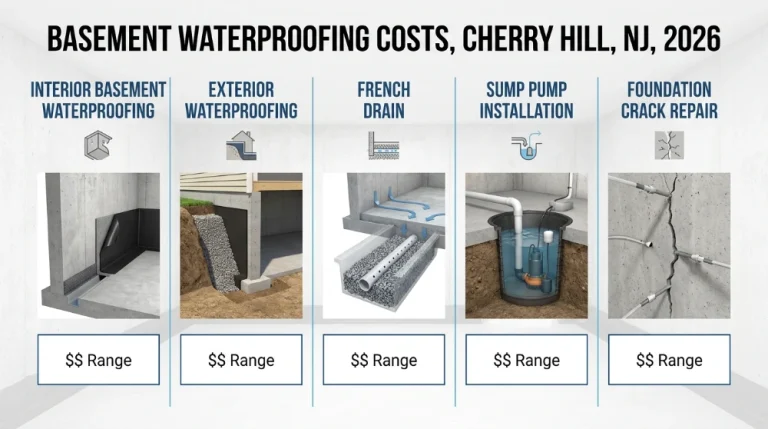
- Waterproof interior and exterior walls where needed. See our full list of waterproofing services and our local cost guide.
Frequently Asked Questions
How much will insurance pay for a flooded basement?
It depends on your coverage limits and whether a covered cause damaged the basement. You pay your deductible first, commonly $1,000 or more. Standard claims may pay actual cash value or replacement cost. Flood policies carry separate deductibles for building and contents, and NFIP limits are $250,000 and $100,000.
What two events are not covered under homeowners insurance?
The two most common exclusions are flooding from outside water and earth movement, such as earthquakes, landslides and sinkholes. Standard policies also exclude sewer and sump pump backups unless you add an endorsement. Flood and earth movement coverage are sold separately from a standard homeowners policy.
How to get basement flooding covered by insurance?
You cannot add coverage after a loss, but you can protect yourself going forward. Review your policy today. Add a water backup and sump overflow endorsement. Buy a separate NFIP or private flood policy, remembering the 30-day waiting period. Then document and report any future damage promptly and accurately.
Does State Farm (or major insurers) cover basement flooding?
Major insurers follow similar patterns. State Farm says standard policies generally do not cover floodwater entering from outside, and that sewer backup and sump pump failure usually need a rider. Liberty Mutual and Allstate offer water backup coverage as an option. Exact terms vary by insurer, state and policy, so confirm yours.
Final Thoughts
Is basement flooding covered by homeowners insurance? Sometimes. Sudden leaks from inside your home usually are. Rain, groundwater, seepage, sump pump failure and sewer backup usually are not, unless you add the right protection.
The good news is that the gaps are easy to close. Add a water backup endorsement. Consider a separate flood policy, even outside a high-risk zone. And fix the causes of water entry before they turn into a claim.
If your basement is already leaking, damp or showing cracks, request a free written estimate from Waterproofing Cherry Hill or call (856) 652-8553. We are licensed and insured in New Jersey and serve Cherry Hill, Marlton, Voorhees, Pennsauken and Camden County. Our FAQs answer more common questions, and our guide on whether basement waterproofing works explains your options.
This article is general information, not insurance or legal advice. Coverage varies by policy, insurer and state, so confirm details with your agent.